Fall Cleanup Services in Randolph, NJ: What the Work Covers and When to Book It
Fall cleanup services in Randolph, NJ, are one of the few landscape jobs where the calendar is not negotiable. The oaks and maples across Morris County drop on their own schedule, the ground freezes on its own schedule, and the weeks between those two events are the entire working window. Everything else about the job can flex. That does not.
BTS Landscaping runs its crews out of 1021 State Route 10 in Randolph, with more than 500 completed projects behind them, and the properties that come through winter cleanest are consistently the ones booked before the first heavy drop rather than after it.
This piece covers what a proper cleanup actually includes on a property in this area, how many visits a mature lot needs, and what a quote should specify so that two numbers can be compared honestly. It also covers the part homeowners ask about most: how late is too late.
Related: Maintaining Luxury Landscapes: Trimming & Pruning Essentials for Bernardsville, NJ, Estates
What Does A Fall Cleanup Include On A Morris County Property?
The core scope is leaf removal and property clearing, lawn and bed cleanup, perennial and plant cutbacks, debris removal and disposal, a final mow and edge, and preparation of planting areas for winter. That is the scope we quote against, and it is worth reading closely because the phrase covers a wider job than most homeowners picture.
Leaf removal is the visible part. The less visible part is what happens in the beds: cutting back perennials to the right height for their species, clearing accumulated litter from the crowns, and pulling debris out from behind shrubs where it would otherwise hold moisture against stems all winter.
Disposal matters more than it sounds. Leaves blown into a wood line do not disappear; they compost slowly, smother whatever is growing beneath them, and return as a matted layer in spring. Hauling material off the property is a real line item and a real cost, and a quote that omits it is quoting a different job.
Why Does Leaf Litter Cause More Damage Here Than Homeowners Expect?
Northern New Jersey soils are heavy, and heavy soil combined with a wet mat of leaves holds water at the crown of the grass plant for weeks. That is the condition snow mold favors. A lawn that goes into winter under an inch of packed leaves frequently emerges in March with grey or pink patches that were not there in November.
The same mat blocks light. Cool-season turf continues photosynthesizing well into December in this area, and it is that late-season activity that builds the carbohydrate reserves the lawn spends waking up. Covered turf skips that, and the difference shows up in April rather than December.
Beds have a parallel problem. Wet litter piled against woody stems creates the humid, dark conditions that suit voles and fungal issues equally well. Clearing it is less about appearance than about what the property looks like six months later.
How Many Visits Does A Property With Mature Trees Need?
It depends almost entirely on the canopy. A property in one of Randolph's newer subdivisions with young ornamental trees may finish in a single visit. An older lot in Mendham or Harding with mature oaks will not, because oaks hold their leaves late and drop in stages well after the maples have finished.
Two visits is the common answer for established properties in this area: one in mid to late autumn once the bulk of the maple and ash drop is down, and a second after the oaks release. Trying to compress that into one visit produces either an early cleanup that gets buried or a late one that leaves the lawn covered for six weeks.
Properties with significant grade or wooded edges sometimes want a third pass, because wind moves material into low corners and against structures repeatedly through the season. We would rather price that honestly at the walk-through than surprise a homeowner with it in December.
When Should Fall Cleanup Services Be Scheduled Here?
Booking happens well ahead of the work. The window is short, every property in the county shares it, and crews route geographically to make the volume workable. A homeowner calling for a first-time cleanup in late November is calling at the point where the schedule has limited flexibility left.
Booking early also buys sequence rather than only a date. Properties on the schedule before the season starts get routed with their neighbors, which is what makes a two-visit plan land at the right two moments instead of whenever a truck is free. Properties added in November get fitted into gaps, and gaps do not follow the oak drop.
The practical guidance is to have the visit or visits on the calendar by early autumn, with dates that can shift a week in either direction depending on how the drop actually runs that year. Weather moves the drop; it does not move the freeze, which is the deadline at the other end.
Late is still better than not at all. A cleanup completed after the first hard freeze recovers most of the benefit for the beds and nearly all of it for appearance, though the turf will already have spent several weeks covered. That is the tradeoff, stated plainly.
What Happens To Planting Beds During The Cleanup?
Cutbacks are species-specific rather than uniform. Some perennials are cut low, some are left standing through winter for crown protection and structural interest, and some ornamental grasses are deliberately held until spring. A crew that shears everything to the same height is working quickly rather than correctly.
Beds also get cleared of the season's accumulated debris, edges get redefined where they have crept, and any plant material that failed over the summer gets noted for replacement. Our plantings work often begins with exactly that list, compiled during a fall visit and executed the following spring.
What we do not do is dress beds with fresh mulch in late autumn as a matter of course. A heavy layer applied over cold, wet ground insulates the soil in the wrong direction and gives rodents a winter corridor along the stems. Where a bed needs it, we say so; where it does not, we say that too.
How Does Cleanup Timing Affect Seasonal Display Work?
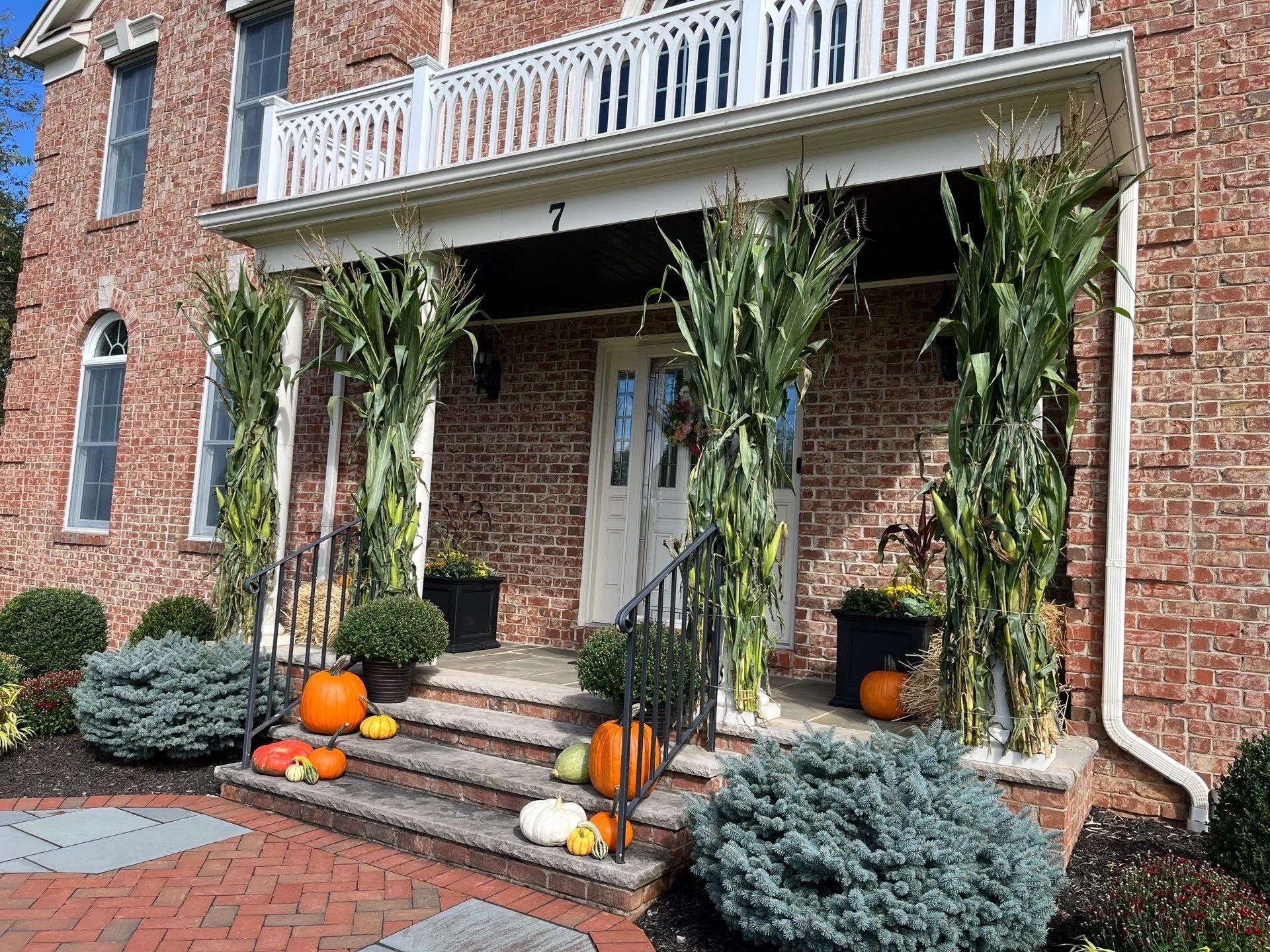
The two run together, and the sequence matters. A front entrance dressed with cornstalks, hay bales, mums and pumpkins looks the way it should only if the beds and lawn behind it have already been cleared. Placing a display over an uncleaned bed is the fastest way to make a good display read as an afterthought.
Our standard for that work is the whole front of the house rather than a token arrangement. Corn stalks up the columns, bales, mums massed rather than dotted, and material scaled to the elevation. Three pots on a brick pier does not read as our work, and we would rather not put our name on it.
For properties that carry through into winter decor, the same logic applies to the transition. Autumn material comes off, the beds get a second clearing, and winter greens go on to a clean surface. Scheduling those two visits together in advance costs less than treating them as separate calls.
Related: From Design to Maintenance: A Short Guide to Landscaping in the Madison and Mendham, NJ Areas

What Should A Fall Cleanup Quote Specify?
Number of visits, first. A per-visit price and a season price are different products, and a single number without a visit count cannot be compared against anything. Second, disposal: whether material leaves the property and whether that haul is included.
Third, the bed scope. Leaf removal from turf is straightforward; perennial cutbacks, shrub clearing and edge work are where labor hours accumulate, and a quote that stays silent about them is quoting turf only. Fourth, gutters, if the property has heavy overhang, since that is a common assumption on both sides.
Fifth, the wood line, on properties that have one. Whether a crew clears to the tree line or stops at the mowed edge is a real difference in hours, and it is the item most often assumed rather than stated. A homeowner who has been blowing that edge themselves every November should say so at the walk-through, because it changes the number and it changes the visit count.
We price this work to be reliable rather than to be the lowest number in a stack of three. What that buys a homeowner is a crew that shows up on schedule during the six weeks of the year when scheduling is hardest, and a scope that does not shrink when the season gets busy.
How Does Cleanup Fit With Year-Round Property Care?
For properties on an ongoing plan, autumn cleanup is a scheduled phase rather than a separate transaction. Our residential lawn maintenance program carries seasonal cleanup inside it, which means the crew already knows the property, the bed lines, the irrigation heads and where the wind piles material.
That familiarity is worth real money in October. A crew seeing a property for the first time in leaf season spends part of the visit learning it, and learns some of it by damaging things. A crew that has mowed the same lawn since April does not.
For homeowners who want cleanup only, that is a service we sell on its own and have sold on its own for a long time. The point is simply that the two paths price differently and produce a slightly different experience, and it is fair to know which one you are buying.
What Does The Crew Actually Do On Site?
Work runs from the perimeter inward. Beds and hard surfaces get cleared first so that material moves onto the lawn rather than off it, then the turf gets worked in sections toward a collection point. Doing it in the other order means handling the same leaves twice, which is why sequence is one of the clearer differences between an experienced crew and a cheap one.
Blowers do the bulk of the moving, but the finish work is hand work. Material wedged behind shrubs, packed into bed corners, or sitting in the gap between a walk and a wall does not move with air, and leaving it is the most common shortcut on this job. It is also the shortcut that shows in April.
Hard surfaces get cleared last so that the property is left clean rather than dusted with debris from the final pass. Walks, patios, driveways and steps all get blown down, and any material tracked onto the street goes with the crew rather than into the storm drain.
The final mow is genuinely the final one, and it is cut slightly shorter than the summer height. A long blade going into winter mats under snow; a very short one loses the insulation it needs. The target is a controlled middle, and the crew adjusts it by how the season is actually running rather than by a fixed date.
Which Properties In This Area Need The Most Attention?
Wooded lots on the western side of Randolph and through Mendham carry the heaviest load, because they are catching their own canopy plus whatever the wind brings off the surrounding tree line. Those properties are the ones where a third pass earns its cost, and where skipping the wood-line edge means the leaves come back.
Properties with significant grade are second. Water and leaves both run downhill, and a low corner at the base of a slope accumulates a mat several inches deep while the rest of the lawn looks fine. That corner is usually the first place a homeowner sees turf damage in spring, and it is rarely visible from the driveway in November.
Corner lots and properties fronting a main road pick up road debris on top of their own. Route 10 does this to our own frontage every year, which is part of why the beds along it get cleared and replanted seasonally rather than left to accumulate.
The lightest properties are newer subdivision lots with young ornamental trees and neighbors whose canopies are equally young. Those genuinely do finish in one visit, and we price them that way rather than selling a second pass that the property does not need.
Book Fall Cleanup For Your Randolph Property
Leaf drop arrives on its own schedule, and the calendar fills in the order the calls come in. Call BTS Landscaping and we will walk the property, set the visit count honestly against your canopy, and put firm dates on the books before the drop starts.
If you want the seasonal display handled on the same schedule, we will price that too. Either way, the earlier the walk happens, the more of the autumn calendar is still yours to choose from.
Call us to get your Randolph property walked and scheduled while there are still good dates left on the autumn calendar.
In Summary
Does one visit cover a Randolph property with mature oaks?
One visit rarely covers it. Oaks in Morris County hold their leaves considerably later than maples and ash, and they release in stages rather than all at once. Most established properties here are scheduled for two visits, with the second timed after the oak drop finishes. BTS Landscaping sets the visit count at the walk-through based on your actual canopy rather than applying one package to every address.
Are cleanup visits coordinated with an existing maintenance schedule?
They are, for properties already on an ongoing plan with BTS Landscaping. The autumn visits are built into the season's route rather than booked separately, and the same crew that has mowed the property since spring performs them. That continuity matters most around irrigation heads, low-voltage lighting and bed edges, which are the things an unfamiliar crew tends to find the hard way.
How late in the season can a cleanup still be booked?
We continue running cleanup crews until the ground freezes hard enough to stop the work, which in this part of New Jersey is typically some point in December and varies year to year. Booking that late means taking whatever dates remain rather than choosing them, and the lawn will have spent several weeks under leaf litter by then. It is worth doing; it is simply worth doing earlier.
Founded on a passion for nature, BTS Landscaping is committed to building and maintaining high-quality landscapes for discerning clients.
We hire only highly qualified, skilled workers who share our priority for the environment and satisfying customers. We strive to exceed expectations and provide maximum value on every project. Our goal is to make a positive impact on the lives of our clients, our employees, our community and the environment.